Grace Jones fundamentally rewrote the visual language of pop culture by transforming her identity into an avant-garde piece of living art. Rising from the conservative rural landscape of Jamaica to the epicenter of global nightlife and high fashion, she did not merely follow trends—she shattered them. By blending sharp androgyny, surrealist art, and unapologetic Black identity, Jones created a blueprint for stardom that continues to shape modern icons from Rihanna to Beyoncé.
🇯🇲 Roots and Rebellion: Early Life and Cultural Background
Birth and Family Heritage
Grace Jones was born Grace Mendoza on May 19, 1948, in Spanish Town, Jamaica. She grew up in a deeply religious, conservative, and politically connected upper-middle-class household. Her father, Robert W. Jones, was a local politician and Apostolic clergyman, while her maternal grandfather was also a church bishop.
A Childhood of Strict Discipline
When Grace was still a young child, her parents relocated to the United States to establish a ministry in New York, leaving Grace and her siblings in Jamaica under the care of her maternal grandmother and her step-grandfather, a man known to the family as “Mas P.”
Mas P was a strict, terrifying disciplinarian who raised the children under rigid, authoritative rules. Physical punishment was frequent, and the children were forbidden from singing anything other than church hymns. Jones would later credit this intense, highly disciplined, and intimidating upbringing as the fuel for her rebellious nature and the creation of her fierce, untouchable stage persona.
Relocation to the United States
In the mid-1960s, a teenage Grace left Jamaica to rejoin her parents in Syracuse, New York. The sudden shift from tropical, conservative Jamaica to the changing social climate of upstate New York was jarring. Jones attended Syracuse University, studying theater, where she began to fully embrace counter-culture movements, experiment with her look, and rebel against her family’s strict religious expectations.
🗽 The Blueprint: How Her Career Started
Breaking Into Modeling
Frustrated by the lack of opportunities for dark-skinned Black women in the American modeling industry at the time, Jones relocated to Paris in 1970. Europe embraced her striking, unconventional look immediately.
She signed with Wilhelmina Models and became a roommate to fellow future icons Jerry Hall and Jessica Lange. Jones quickly became a muse for legendary fashion designers who were captivated by her statuesque, 5’10” frame and sharp features, including:
- Issey Miyake
- Yves Saint Laurent
- Karl Lagerfeld
- Kenzo Takada
She graced the covers of Vogue and Elle, establishing herself as a high-fashion force.
[Syracuse University] ➔ [Moves to Paris (1970)] ➔ [High-Fashion Muse] ➔ [Studio 54 / Disco Era]
Transition to Music and Studio 54
By the late 1970s, Jones transitioned from the runway to the recording studio. She signed with Island Records and became a central figure in the rising New York disco scene, frequently headlining the legendary nightclub Studio 54.
Her early “Disco Trilogy” albums—Portfolio (1977), Fame (1978), and Muse (1979)—solidified her status as a dance-floor diva and an icon within the LGBTQ+ community, who championed her boundary-pushing fluid style.
🎨 The Aesthetics of Power: Architectural Visuals
Subverting Gender Norms Through Androgyny
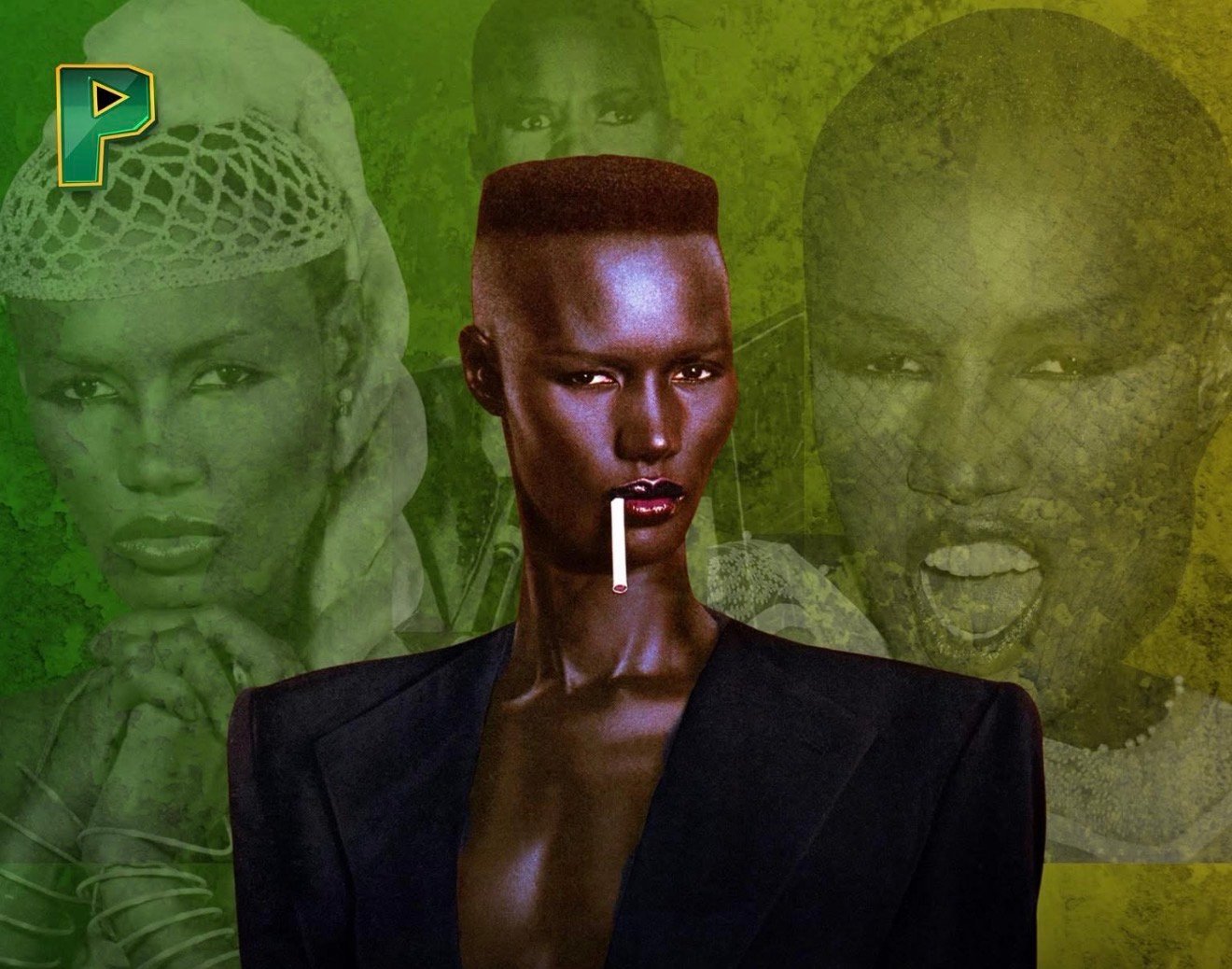
Before “gender-fluid” or “androgynous power dressing” became industry buzzwords, Grace Jones was masterfully executing them. She turned her body into a canvas of sharp lines, opting for severe, angular tailoring rather than the soft, hyper-feminine silhouettes dominant in the late ’70s and ’80s. Her signature flat-top fade haircut and architectural, sharp-shouldered men’s suits aggressively subverted traditional expectations of how a female artist should present herself.
The Surrealism of the Goude Collaborations
A monumental shift in pop culture imagery occurred when Jones teamed up with French graphic designer Jean-Paul Goude. Together, they treated her body as a piece of living, geometric sculpture. Utilizing pre-digital photomontage, Goude physically cut up and rearranged photographs of Jones to elongate her limbs and contort her into impossible, athletic, and robotic poses.
The album cover for Nightclubbing (1981)—featuring Jones in an Armani suit with exaggerated shoulders, blue-black skin, and a lit cigarette dangling from her lip—became a masterclass in visual minimalism.
Redefining Black Beauty and Afrofuturism
In an era when Western fashion spaces heavily favored Eurocentric beauty standards, Jones took her dark skin, sharp Jamaican features, and natural hair texture and amplified them into something untouchable, powerful, and majestic.
Alongside visual artist Keith Haring, she painted her body in graphic, tribal motifs, fusing ancient cultural roots with sci-fi, futuristic concepts. This distinct styling served as a massive foundational pillar for Afrofuturism, proving that Black artists did not have to soften their identity or conform to Western ideals to be globally revered.
🏛️ Chronology of a Polymath Career
| Era | Creative Focus | Key Milestones & Works |
|---|---|---|
| Early 1970s | High Fashion & Runway | Muse for Yves Saint Laurent and Karl Lagerfeld in Paris. |
| Late 1970s | The Disco Trilogy | Released Portfolio (1977) and became the queen of Studio 54. |
| Early 1980s | New Wave & Compass Point | Released seminal albums Warm Leatherette (1980) and Nightclubbing (1981). |
| Mid-1980s | Hollywood Cinema | Starred in Conan the Destroyer (1984) and as Bond villain May Day in A View to a Kill(1985). |
| 2000s–Present | Legacy & Return | Released critically acclaimed album Hurricane (2008); featured on Beyoncé’s Renaissance (2022). |
⚡ The Blueprint for Decades of Pop Icons
The visual aesthetic engineered by Grace Jones has heavily shaped the careers of subsequent pop chameleons who use fashion as performance art:
- Madonna: Borrowed heavily from Jones’s hyper-sexualized, dominant stage persona and male-tailored power suits during her 1990s transformations.
- Rihanna: Has frequently channeled the iconic flat-top haircut, sharp tailoring, and unapologetic, fierce Caribbean island energy.
- Lady Gaga: Built her early career on the surrealism, structural headpieces, and boundary-pushing avant-garde armor that Jones popularized decades prior.
- Beyoncé: Channeled Jones’s high-art, sculpture-like fashion ethos for major visual album projects, even inviting Jones to guest-vocal on her track “Move” for the Renaissance album.
By treating her own body and wardrobe as an ongoing art installation, Grace Jones didn’t just participate in pop culture—she created the modern template for how a pop star commands visual authority.